

In part one of this series — seven operational signs you're using AI rather than integrating it — I separated two approaches that get lumped together whenever people talk about using AI.
Using AI means keeping it inside the boundaries of a piece of software — whether you call on it by hand or it runs on its own. Integrating AI means making the organization its boundary: it reads where your data lives, and it writes where the answers are needed. I also offered a simple grid to help you figure out where you stand.
But one objection keeps coming up:
If the AI tool already saves time on its own, why pay more to integrate it?
The answer is simple: because the two approaches don't produce the same kind of gains. And because the gap between them doesn't show up when you make the decision. It shows up later. At a real cost.
The costs of using AI — the ones nobody puts on the invoice
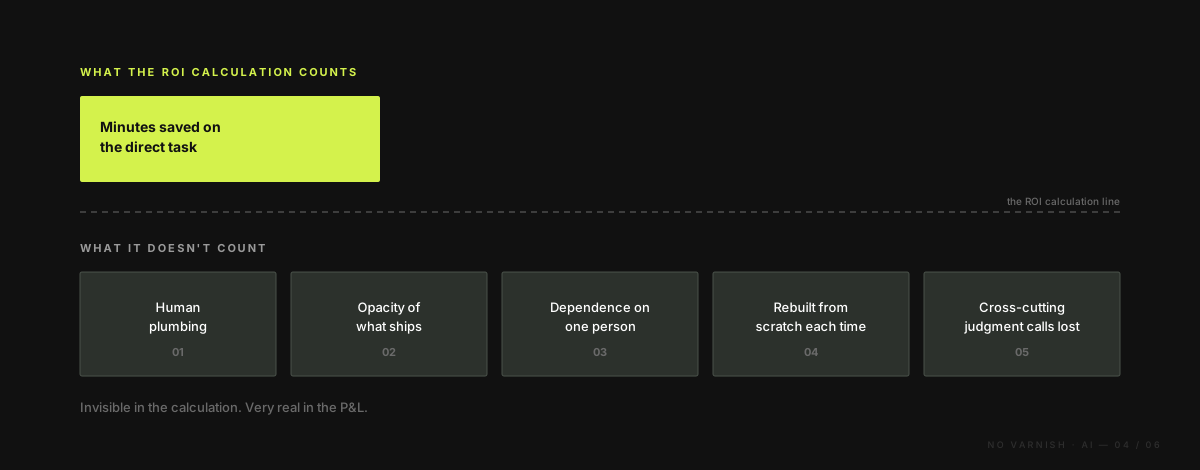
When a leader calculates the ROI of an AI tool, they count the minutes saved on the task itself. What they don't count are five structural costs — invisible in the math, very real on the P&L.
Cost #1 - Human plumbing
All the manual work around the tool. Someone copying and pasting, checking, re-entering, proofreading. That time never shows up in the savings calculation, because it was already there — and the project never set out to eliminate it. It still drags down productivity.
Cost #2 - Opacity
What the AI produces isn't visible in your management systems. Insights don't travel; they're invisible anywhere except where they were generated. The results don't feed any other action. The value evaporates the moment the person who generated it walks away from their screen.
Cost #3 - Fragile human coupling
When the person who ran the tool leaves, changes roles, or skips a step, the system breaks silently. Nobody knows when, nobody knows why the numbers moved or why the results are off. Any use whose reliability rests on one person is a dependency — and a potential point of failure.
Cost #4 - Fragmented use cases
Every new business need kicks off a new, isolated AI project. No shared infrastructure, no common context, no reuse. Eighteen months in, you've paid for the same basic plumbing three times and you're managing three separate maintenance contracts for tools that don't work together.
That's the path to what finance teams privately call "AI inflation" — a growing budget, a growing pile of tools, and no compounding or consolidated gains.Cost #5 - Lost cross-functional synergies
An organization isn't a collection of independent tasks — it's a network of functions that feed each other.
AI that ignores this produces value that stays local.
Sales and operations never meet in the system. Operations and finance never meet in the system.
The cross-functional trade-offs a well-integrated AI could inform in real time are never available when decisions get made. Every one of them is an optimization or performance gain that simply goes unseen.
These missed gains never show up in any ROI, because nobody knows they exist.
Integration gains compound — usage gains don't
This is where the two approaches stop looking alike.
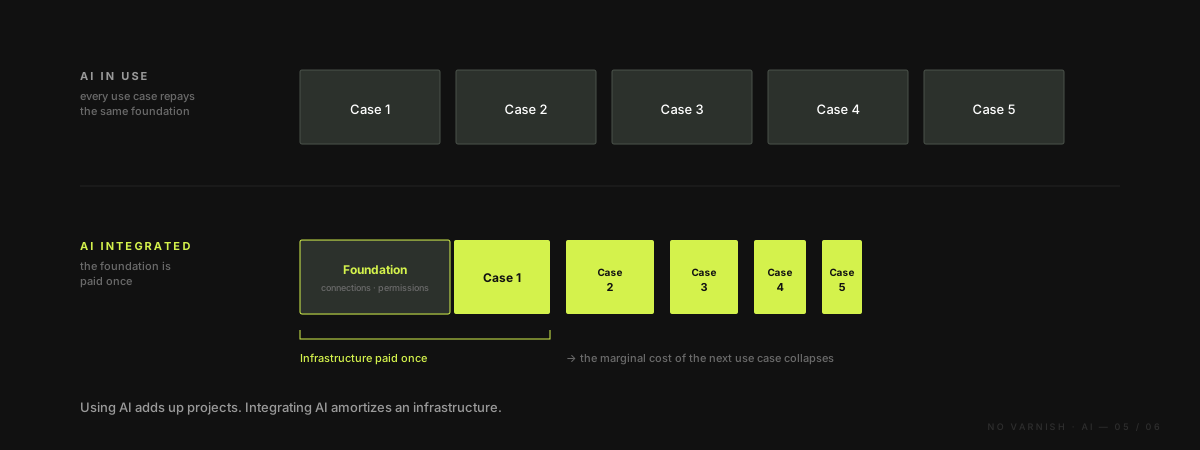
Usage gains are flat. Each use case pays off what it pays off, once, and that's it.
Your tenth use case costs roughly what your first one did, and returns roughly the same.
You're not building anything. You're buying the same thing ten times.
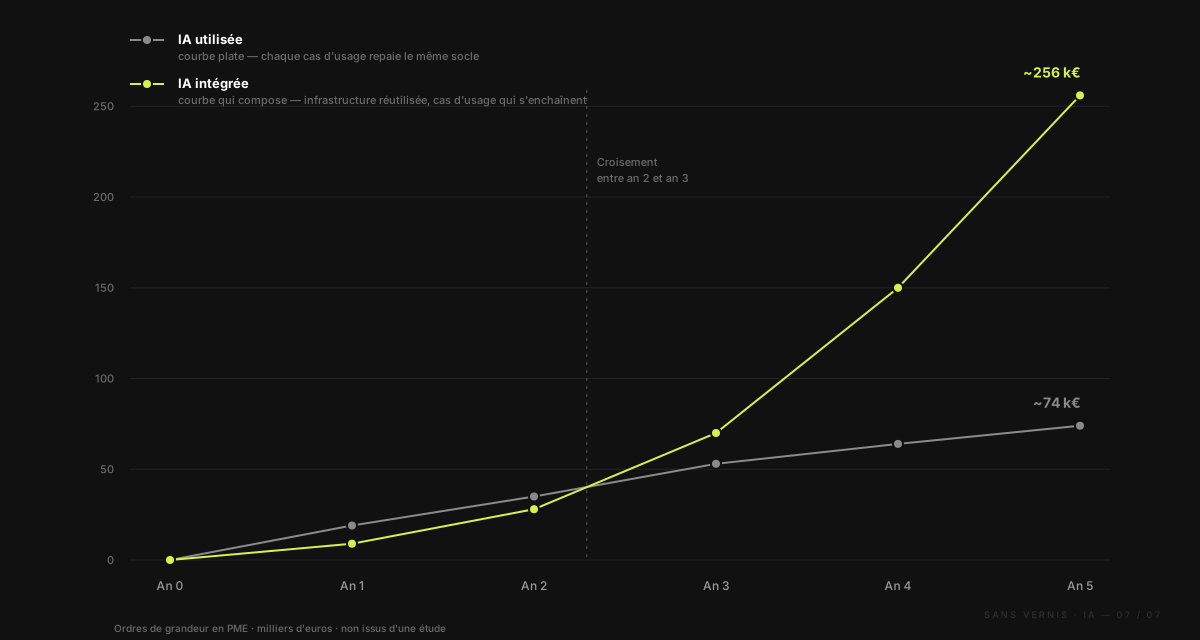
Integration gains compound, for three distinct reasons.
Reason #1 - The marginal cost of the next use case collapses
The first integration pays for the infrastructure: connecting to your systems, managing permissions, data formats, traceability, trigger rules. The second reuses all of it. The fifth is built on a foundation that's already paid for and already proven.
Where usage stacks up projects, integration amortizes infrastructure.
Reason #2 - Context accumulates
AI that writes back into your systems enriches the material the next one will read. What it produces becomes an input for the rest of the organization.
In usage mode, the output dies in an inbox: it served once, and it will never serve again.
In integrated mode, every run grows the stock of usable context — and with it, the quality of everything that comes after.
Reason #3 - Cross-functional trade-offs become possible
When sales, operations and finance live in the same system, integrated AI can bring every function and every role what it didn't have before, or could only get with difficulty. A margin slipping on one customer segment, caught before the books close. A capacity crunch, spotted while deals are still being signed.
That's the moment the gain stops being time saved and becomes an advantage in deciding and acting — the only kind of gain a competitor can't close by buying the same tool you did.
There's also a timing asymmetry, and it's what traps leaders.
The two curves cross. At three months, usage wins: it's already shipped, it's already saving minutes, it demos well in a meeting.
At eighteen months, the gap is structural and can't be closed. Yet leaders compare the two approaches at the point of purchase — the one moment in the cycle when usage looks like the better choice.
Why usage is the default
Integration is the longest and most expensive part of an AI project. It's also the first thing cut when you want to ship fast.
A two-week prototype never has time to get wired in — it stays inside its boundaries by design.
Speed of delivery and depth of integration are in structural tension, and it's almost always the second one that gives.
And delivery isn't the only issue. Integration assumes you've first understood how the organization actually works — how its functions feed each other, what flows between tools, what needs to rise to decision-makers and what needs to flow down to execution.
That work takes organizational reading, not just technical skill.
Most vendors do the opposite: they pitch tools without ever having read the organization. That's exactly why their tools never integrate.
Where to start
Three principles are enough to avoid falling into the default.
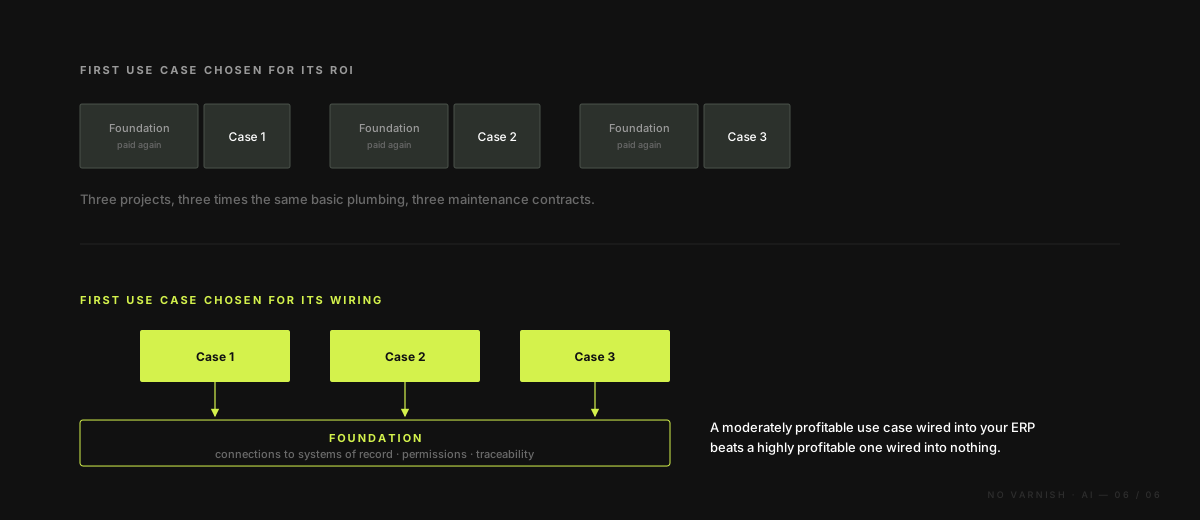
1. Choose your first use case for its wiring, not its ROI.
The reflex is to start with the most time-consuming task. That's a sequencing mistake: the first project pays for the infrastructure, so choose it for the connections it puts in place — the system where your reference data lives, permissions, traceability.
A moderately profitable use case that plugs you into your ERP beats a highly profitable one that plugs you into nothing. The second and third will collect their gains without paying for the foundation again.
2. Ask for the data-flow map before the demo
A vendor who has read your organization can tell you, before writing a single line of code, what the tool will read, where it will write, what event will trigger it and who it will notify. If they lead with the demo and leave the architecture for later, their priorities already tell you what you need to know.
3. Decide where the output lands at the scoping stage
This is the part that always gets cut, because it never shows up in a demo: the output that gets written into the record, the information that rises to management, the event that triggers the next step.
If nobody has written down exactly where the AI's output lands, it will land in an inbox — or a Slack thread.
And one timing constraint that applies to all three: none of this gets decided after the fact. You don't retrofit integration onto a tool that shipped in isolation — you pay for it again.
The bottom line
AI you use is a smart calculator. Useful, limited, and paid for again with every new need.
AI you integrate — that lives in your systems, shares its infrastructure with other uses, and understands the network of functions it serves — becomes an organizational capability.
The first saves you minutes. The second changes what your business is capable of.
The difference isn't in how smart the model is. It's in the plumbing you agreed — or refused — to build.
Before your next AI project
Reading the organization before proposing the tool is the work I do: what moves between your systems, what needs to reach the decisions, what your first project should plug you into. If you're scoping an AI project, or trying to figure out why the one you have never compounded — that's what LEAD is for. Strategy and implementation, from scoping through delivery.
And if you want to see what a compounding gain looks like: myVP is the AI Chief of Staff built on this principle — every run writes back into the systems the next one will read, so the context it holds grows instead of starting from zero.